Moscow Edition. Round Three

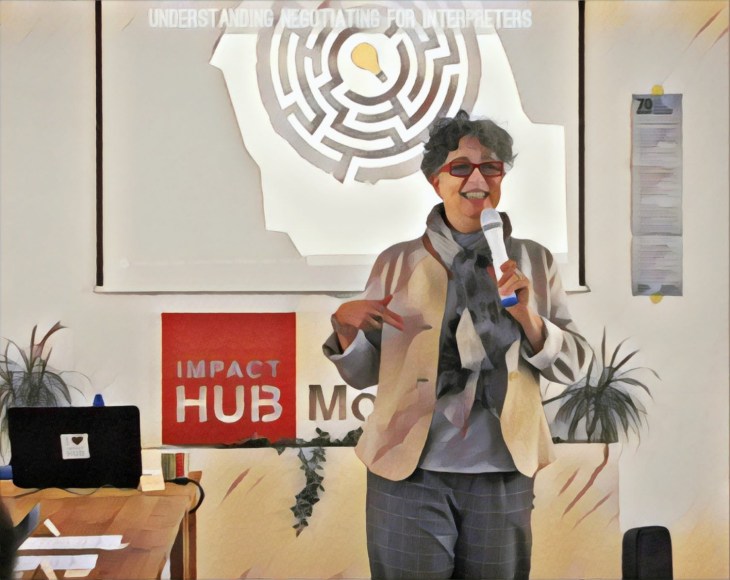
Following a relaxing summer – yes, we did need to rest after all of our editions in the Americas – we thought it was high time we returned to Russia, and so the third Moscow Edition of Know Your Worth: Understanding Marketing and Negotiating for Interpreters took place this past weekend, on 30 September 2018. And since it just happened to coincide with the International Translation Day we thought we’d start by wishing you a happy belated St Jerome’s Day!

IMG_Gothic_20181006_191821_processed

It was the third time that the seminar was held in Moscow, and the second time we teamed up with the Cosines International Contest for Conference Interpreters, as our instructor Julia Poger joined the jury of this all-Russia turned international competition, and gave a talk on Seeing Structure and the role of analysis in conference interpreting as part of their three-day conference.

IMG_Gothic_20181006_191754_processed

We also thought it was time to experiment, to shake things up a little bit, so we decided to revert to our original, one-day format, and the results were as interesting as they were exciting. We still focused in great detail on marketing and negotiating, and we covered such questions as branding, position, and client relations, but this time the speed was slightly different. True, this meant that everything had to go faster, and was considerably more intense than usual – even though some of you might say it’s hard to imagine things getting even more intense – but that also meant a new rhythm, new dynamics, and a much livelier discussion after the event.

IMG_Gothic_20181007_072339_processed

We started by talking about the mindset necessary for successful marketing, and covered some general principles (as well as a number of highly practical aspects) of pricing and negotiating, all necessary steps in building a more sustainable and much more successful interpreting business. We were also able to devote some time to looking into how the interpreting profession is perceived from the outside, all in order to better understand our potential and existing clients.

The seminar covered all the bases for me. From reaffirming some practices I had tried out tentatively or providing applicable insights into “something that had felt reasonable to do somehow maybe,” to being an eye-opener.
Fedor Makhlayuk

Despite this edition being held in a special one-day format, we still wanted to see our participants brainstorm at least a couple of new cases together, as this often leads to them finding new and exciting solutions to different marketing and negotiating problems. It also means that they are more likely to start implementing the new principles and ideas sooner, and in a more direct manner. And once again we were not disappointed. On the contrary.

We were particularly happy with the way this edition’s participants responded to the new information, and how they took to the format, and all the commentary and remarks showed that they had come prepared, and with a solid understanding of their respective markets, but with an open mind and a desire to learn more, and to figure out how to navigate it better and more efficiently.

It was super helpful and I’ve already used some of the techniques today trying to ask a client some questions rather than blindly giving them my rates.
Natasha Kharikova

We always say that it’s best if people come prepared, and with a well thought through agenda, and with this group this was clearly the case. Perhaps that’s why the one-day format didn’t seem as daunting as we had feared at first, and why it seemed that everyone had found answers to at least some of the questions bothering them, and for that we are immensely grateful.

Notwithstanding my already considerable experience on Russian interpreting market, I’ve learned a whole number of new insights from Julia regarding the principles of self-promotion among prospective clients, psychology of negotiations, ways to convince the customers of the value of interpreting services and the need to pay for them adequately.
Alexey Prokhorenko

IMG_Gothic_20181006_190258_processed

It’s become a tradition of ours by now that we devote considerable attention to the general atmosphere we create at the seminar, and we were extremely lucky – and very grateful – to be able to return for the second year running to the truly incredible Impact Hub Moscow. We would like to thank their team for all their help in the run-up to the seminar, as well on the day, and for making sure our participants had a wonderful time and nothing to worry about, except getting to the seminar, and getting the most out of it.
IMG_Gothic_20181006_190640_processed

Last year we thought that we’d found our perfect Moscow location, and that we could not have possibly wished for a better place to hold the seminar. This time simply proved us right:  a beautiful location in the heart of Moscow, wonderful atmosphere, and lovely people to help along the way – in all honesty we could not have wished for a better place.

IMG_Gothic_20181006_185744_processed

If you would like to hold a Know Your Worth seminar in your area, please contact us via this website, or by contacting the seminar organizer Tatiana Kaplun at kaplun.tatiana@gmail.com.

The Business of Interpreting: FAQ 10 – How can I check my profit margin?

I just walked 3000 steps more today than yesterday! Recently I was given a pedometer, and now I can see how close I am to the ideal 10,000 steps per day. And more to the point, I can keep track of my performance.

As interpreters, there are metrics we should be tracking in our business as well: How many days did I work last year and the year before? How much did I earn during each of those periods? We may become even more detailed, noting the types of clients – international organizations, individual businesses and sectors, government ministries, courts, etc.

Two key metrics to evaluate profitability

As business people, there are two essential metrics that we should track, ones we hear about whenever we watch Shark Tank and Dragon’s Den: CAC and LTV.

CAC, or customer acquisition cost, is a business person’s way to understand if their clients actually make them money. In our case, CAC is the cost of convincing a client that they want to buy our service.

To put it simply, CAC may be calculated by dividing all the costs spent on acquiring clients by the number of clients acquired over the same period. For example, if we spent 1000 CX (currency X) on marketing in a year and acquired 10 clients, the CAC for each client is 100 CX.

In our case, we could measure CAC expressed in money or in time, since we usually charge by the day and we know what our day costs. If our daily fee is 800 CX (100 CX per hour for an 8-hour day, including all lunch and coffee breaks, to make the math easy), we just spent the equivalent of 10 hours marketing, and were able to acquire 10 clients, each with a CAC of 1 hour.

If we then consider how much we project to earn from a client over time, the LTV or customer lifetime value, we can determine if that individual client is profitable, and then compare that client to others to see which are the most profitable. In other words, we can see who is helping us to cover our expenses and earn us a profit, and who is literally costing us money to work for.

How it works

So let’s say it took us the equivalent of 4 hours to market to Client A before s/he agreed to sign a contract for 3 days (3×8, or 24 hours) of work. That client is profitable to the tune of 20 hours.

On the other hand, if it took us 10 hours to convince Client B, who ended up hiring us for only one day, Client B cost us 2 hours. If we do not expect to work for them again, and they are not amenable to giving us a referral or a testimonial, then Client B was not worth the time we invested.

Know your cost of living

Before doing this exercise, make sure you understand your expenses on a monthly (recurring costs such as rent or mortgage, food, health insurance, transportation, child care, office supplies, etc.) and annual basis (monthly expenses plus all one-off payments such as a car, a holiday, a computer, an emergency fund, etc.). Divide this grand total by the number of days you can realistically expect to work in a year to get the bare minimum rate you must earn per day worked to be able to break even. (Download Julia Böhm’s excellent article for information on what to include by clicking here.)

For example, if you must earn 2000 CX per month, then in the case above you would have covered only 1800 CX of your monthly expenses (Client A brought in 2000 CX, and Client B cost you 200 CX). So you would need one more day of work for someone who is easier to sell to than Client B.

If we expect to work for a client again, and don’t have to expend more effort or money to convince them to hire us, the LTV just keeps going up. So if we could plan on Client A hiring us even one more day, we would have just earned another 800 CX at zero cost. Whereas, unless they radically change their behavior or give us lots of referrals or an amazing testimonial, we should just stop trying to sell to Client B. After all, why keep a client who continuously makes changes, thus using up far more time than we have budgeted for? Let them go!

Of course, we may decide to work for clients who don’t make us much, if any, money – but only if we know our expenses, that they are covered, and we have another reason to work for them. Reasons abound: we like the cause, we want to gain a toehold in a new market, we want the prestige… but we must know what those clients cost us.

Evaluating your clientele

So how do you do this? List all your current clients, and try to remember how much money or time you spent in convincing each of them to buy your services for the first time. Expenses would include the cost of one business card, time writing emails, a portion of your website, any dedicated expenses such as transportation to a meeting, etc. It may have been very little, if it was a referral from another client; it may have been a lot, if it was someone whom you had to introduce to interpreting.

Do this for all your current clients and rank them by CAC. Do you notice any trends? Are clients from a particular industry less expensive to acquire than others? Make sure to do this exercise for any new client you acquire.

For the same clients, consider how many days you have already worked, and how many more days you might realistically work for each, as well as how much more money, time and effort you will have to expend to convince each of them to hire you again.

Then calculate how much these clients could earn you and see if there are any common features among them. If there are, this should be your niche, your specialization. In fact, this approach could be another way to come at the ideal client question I posed in FAQ 3: If you already know that your most profitable sectors (lowest CAC and highest LTV) are electric power generation, or environmental protection, then you have found your ideal client niche.

If this niche isn’t your favorite, consider if you can make it a favorite and specialize. You have already made inroads into the sector, which will save you a lot of preparation and research time for future jobs, meaning that your effective daily earnings have just increased without having to increase your nominal fees.

If you can’t, then try and understand why you are able to market yourself so successfully to one niche, and not so successfully to another. Once you have that figured out, your business should grow in your ideal niche, and you will know for certain that all your clients are profitable.

Time to start keeping track of your metrics!

Originally published on the blog of the International Association of Conference Interpreters (https://aiic.org/site/world/newsEvents/blog)

The Business of Interpreting: FAQ 9 – What is the customer decision journey?

What will trigger a potential client’s realization that they need an interpreter? And how will they go about finding one? Hard to say right off the bat, so let’s start by thinking about how we search for something, for example terms for a medical conference. The internet, of course – but where exactly?

There are many search engines available, bringing up lots of websites – some gathering all sorts of terminology, others giving you just one term at a time. One of the medical speeches will be about how substances in smaller quantities can be helpful, but larger can kill you – digitalis is one example. So you look up digitalis and get lots of photos of flowers, one of which you just saw in your garden. Really? What’s its common name? Foxglove! Hmm, where did that name come from? And you find that in various Gaelic languages, it’s “folksgloves,” like fairy folk. Then you wonder, do languages other than Gaelic mention the fairies when talking about this plant? And down the rabbit hole you go, not looking up from your computer for hours.

The internet has so many different paths that no one’s journey is alike, even if they start at the same place. And really, maybe no one even starts at the same place either – you noticed the digitalis, maybe another interpreter focused on nanoparticles.

Our potential clients face the same problem. They could start with a search for linguists; they may understand that they want spoken or oral translators. They might even know the word interpreter, though some of those hits will bring up actors or computer programs that execute other programs.They could look for an individual, or an agency. They may already know someone who knows someone. Or they may simply call the local university to ask for a student who speaks that language. Or the embassy of that country. There is no set path.

The customer decision journey

So let’s take a look at the typical customer decision journey. It starts off with a trigger, something that prompts a search, in this case for an interpreter. That trigger could be anything – the boss wants to invite a famous speaker from another country to the AGM, the CEO has just thought about expanding into overseas markets, or the EU suddenly realizes that all their French interpreters with German will be retiring in the next few years. In other words, it could be anything.

The next phase of the journey is research. This is the scary part, as clients most probably don’t know you, may not even be aware of your industry, and they could go anywhere. They have multiple paths available, such as recommendations from friends and colleagues, television, print media, the yellow pages, and of course the internet.

Social media may help, if you are a prominent contributor of content that educates buyers on your own website as well as on LinkedIn and other platforms where serious clients would expect to find a professional. But it may also hurt, since it is easy to find others doing the same thing as you, as well as numerous other distractions. And SEO doesn’t always work here, e.g. if the client heads in a direction that is different from what you consider logical – keep in mind that phone call to the embassy! This phase is when clients gather and evaluate most of the information they need to find the interpreter(s) they will finally hire. In today’s world of immediate gratification, it may take very little time.

Once they have evaluated the information, clients start contacting the interpreters and agencies they found. In fact, well over fifty percent of their buying process will have been completed before they ever contact anyone – which means that clients already have in mind a ranking of the people or agencies they are contacting, and if the first person who answers even comes close to what the potential client wants, they will most probably get the job.

So any information they get from you both during and immediately after the search phase will be critical, as it will differentiate you from the mass of other providers that they are in effect interviewing.

This is where all your homework on what value you provide and how you differ from other interpreters will come in handy. Never merely state a price and end the call – you must have a conversation. The easiest way to start would be by asking where they found you, which is good market research for you as well. After that, make sure to ask all the questions you need to do due diligence on the client and the event, and listen carefully to the answers. If their problem is one you can solve, let them know that you will get back to them in [name a time] with an offer. Then get back to them at that time without fail, to start building trust.

The next point on the journey is when you are offered the job. This is only the halfway point in the customer journey, and takes little time, just like the trigger. It takes place once and is the start of the second half of the cycle, a portion that most of us ignore.

Groundwork for the future

You shouldn’t think that you can simply sign the contract, provide the service, get paid, and have a satisfied client. You may not realize it, but there are multiple contacts you will have with the client during the process of providing your services: obtaining documents, providing input on equipment, advising on how to ensure the event is truly multilingual as opposed to an event with a superficial patch of last-minute interpreter hires. Each one of those contacts will lead your client into thinking that you are easy to work with, fulfill their needs, and have an engaging personality – or it could prove the opposite. At the end of the day, it isn’t just your interpreting – it is this phase that makes or breaks you.

In fact, mediocre to bad customer experience is the norm, so anything you can do to enhance this relationship and experience will ensure that clients see you not simply as a service provider, but as the expert and partner that contributed to a successful event. Clients will not only know, like and trust you for the future, but they will become your advocates in a densely crowded and highly competitive market.

If a client is happy, ask for a written testimonial or a recommendation online, and for possible referrals to new contacts. The written aspect of a testimonial cements their opinion of you in their minds, and the social aspect shows others that clients speak positively about you, which of course is much more valuable than you talking about yourself.

At this point, you have come full circle back to when something new triggers their need to hire an interpreter. But since the previous experience was so positive, why would clients waste time repeating the research and evaluation process? They call you directly, and you take the shortcut directly to the point where you are hired again.

This is a simplified model of how a client finds a service provider. There are many other models that make the rounds, such as the funnel model (you run into that when you click to receive a free report and are required to give your email address to have it sent to you), or the hero journey (described by Joseph Campbell and exemplified by Luke Skywalker), but this one sums up best what we ourselves have to deal with when clients find us.

I bet that most of those that called you out of the blue have already done a minimum of research, at least to find your name, even if that was simply searching for “spoken translator” + “your foreign language” + “your city”. It’s your job to then make their calls to you into such engaging conversations, showcasing your value to them, that they go no further, and become your biggest fans.

Originally published on the blog of the International Association of Conference Interpreters (https://aiic.org/site/world/newsEvents/blog)

Know Your Worth Gets Ready to Hit New York

It seems that the Know Your Worth community is having its busiest season yet, as following the success of our Know Your Worth marathon, and that of the first ever seminar we held in the USA, we are delighted to announce our return to America, and that registration is now open for our first ever New York Edition.

The seminar will take place on 30 June – 1 July 2018, and we would be very happy to see you there.

eRc861529011666

If you are an interpreter who wishes to improve your relationships with clients and prospects, gain more respect, and negotiate higher fees, then this two-day event is exactly what you need!

You will receive two days of tuition, covering essential skills for any interpreter, costing less than one day’s interpreting fee.

You will be encouraged to take a step back from your own position, and envision the entire client relationship from new perspectives.

What is important to explore?

We will examine the mindset underlying the marketing and negotiating tasks that you carry out every day, so you may acquire invaluable tools that will have an immediate effect on your bottom line.

We will address questions such as:

What can you do to increase your chances of getting the job once you have targeted the client?

What should you avoid saying, or else the client may never hire you – or anyone else?

What phrase should always end your conversations with any client?

How do you increase your chances of earning what you are worth?

We will discuss concepts such as branding, selling, client relationships, pricing, negotiating tricks, and “coopetition,” all illustrated with real-life examples.

Julia draws on parallels with other – often surprisingly similar – professions, and what lessons we may learn from them. She focuses on the upstream work and preparation that must be done before the interpreter advertises his/her services, or negotiates any contracts.

To register, please use the link below, and don’t hesitate to get in touch should you have any questions.

Register here!

Online registration photo_BW

If you would like to hold a seminar in your area, please contact us via this website, or by contacting the seminar organizer Tatiana Kaplun at kaplun.tatiana@gmail.com.

Please stay tuned for more updates, and don’t hesitate to get in touch should you have any questions.

You can also check our Facebook page for regular updates.

The Business of Interpreting: FAQ 8 – What is the most sustainable interpreting market?

Things have been going well, you have lots of work with a great client, you are earning lots of money – and then suddenly bam! Something happens… and now you are making almost nothing. Your loyal client is no longer hiring you more than once in a blue moon. What can you do?

In actual fact, the question should be “what could I have done to prevent it?” Putting all your eggs in one basket is never a good career move – that’s why there are sayings and fables about it. So let’s take a look at clients and how we can make our situation more sustainable.

The myth of the ideal client

Most of us would think that finding that one client who can hire us every day of the year for decent fees and conditions is a godsend. How fantastic, we don’t have to take the time to market, research new jobs, figure out how to work for a new client, or anything else! We are practically employees, but still able to take our vacations when we want to.

Most often, this type of client is the hiring agent in a government interpretation service, an international organization or an agency. You like the work and don’t have to worry. Your contact knows you and your work, likes you and the ease of dealing with you, and trusts you. For them, you are a consistent element, so why would they bother trying to find another?

This is all well and good, but have you considered how fragile this situation is? What happens if your longtime contact falls ill, or retires, or changes jobs? Have you been nurturing an authentic relationship with them so you know ahead of time that they are moving, so you can make plans? Have you been educating this person for a long time, and can you ask them to pass on the fruits of that education to their replacement or to include them in a standard operating procedures file?

Or even more out of your control, what if you’ve been working for an international organization, and your main language combination is dependent on the political or economic situation in the world? In other words, the major country that speaks your language does something the international organization considers to be beyond the pale, and suddenly they no longer hire anyone with your languages?

Or have you thought about subprime loan risks that spread throughout the global economy? Governments the world over cut their budgets, so many international organizations are now just trying to keep their heads above water and there is much less work for interpreters.

These are all-too-familiar situations that can happen to any of us at any time, and all have happened to some of us. We can cross our fingers and hope that things will pick up again in the near future –though this isn’t very helpful because while the economic situation has only just started moving, it looks to be sinking again; the political situation looks frozen. And how long will this new hiring officer who actively doesn’t want to hire us stay in the job?

Or is there a more sustainable way of finding regular work?

Alternatives

Somewhat counter-intuitively, direct clients on the private market look to be the most sustainable way of working as a freelance interpreter today. Such clients are easier to get to know, and have multiple means of entry – you may get a toehold in the export department, and then get called to work with the marketing and sales departments. Once the company has a long term relationship abroad, you might get brought in to help manage their customer relations. And any time anyone makes a trip to visit that market, you have another job.

If you think about it, even if governments aren’t talking to one another, individuals still do. There will always be some sort of business relationship that people need to maintain. When deals go wrong, there will be international arbitration. And there are always some sort of civil society efforts that need interpreters. It may not be what you would strictly call conference interpreting, but these are fields that many of us have worked in.

If you have a strong base of private clients, even if they are concentrated in a particular niche, you don’t have to worry as much if one of them disappears. Even if they are in the same niche, they maybe at different stages in developing their foreign markets. You don’t have to worry when the hiring agent at one of them changes, that the economic situation in one company will be reflected in exactly the same way in all of them, or that a suddenly different political situation will hit each of them identically.

Moreover, if you have been educating all your points of contact to work with you as a full member of the team, and if you have been maintaining an authentic relationship with them, then when they move on, it may be a great opportunity for you! They may leave instructions for their successors, who will then understand that the company already knows, likes and trusts you; you’ll have less marketing to do to keep them as a client. Plus, you will have the added value of knowing that a second company doesn’t need the same level of education, because your former contact point is now preaching your cause in the new company.

So if sustainability is the watchword, and market diversification is the best way of remaining sustainable, then put more of your eggs in the direct client basket!

Originally published on the blog of the International Association of Conference Interpreters (https://aiic.org/site/world/newsEvents/blog)

2018. A New Year and a New Paris Edition

Following the success of our three Russian editions, we decided it was time to bring the Know Your Worth: Understanding Marketing and Negotiating Interpreters seminar back to Paris, and that’s where our most recent edition took place, on 20 – 21 January 2018.

It was the first seminar we held after the beginning of the New Year, and we were naturally very excited to meet our new participants, and explore our new location. It was also in many ways it was a very special edition for us, as it symbolised our return to Paris after an almost two-year-long break.

It was also very special in that it brought together the most multinational group of participants we’ve had on the course yet, with colleagues hailing from Belgium, England, France, Russia, Spain, Switzerland, Turkey, and the United States, all working in different language combinations. We’ve also had colleagues with some rare (for the European market) languages join the team, which meant that we had an even greater spectrum of case studies and examples to look at.

The seminar was held in a our now well established two-day format, which allowed for a detailed discussion of the seminar’s two main subjects: marketing, and negotiating. Once again, we were able to dedicate an entire day to an in-depth study of each of the main topics, as well as cover such questions as branding, positioning, pricing, pitching, and client relations, and to discuss the many challenges that we, as freelance interpreters – and freelance professionals – must face on a daily basis.

The KYW training is the fastest path to success for you interpreters out there dreaming of landing THE best clients and THE best deals ever! special thanks to Julia Poger!

Cyril Belange

KYW Paris photo 3

We like to see our participants brainstorm some of the more challenging cases together, in small or larger groups, as this way they are often able to discover new and exciting solutions to different marketing and negotiating problems. We also urge them to share cases from their own experience, as often this prove to be even more interesting to solve than any usual textbook examples.

We would like to thank all of this edition’s participant for taking such an active part in the discussion, and for being so generous with sharing their own cases and experience. This made the discussion even more relevant to the present-day situation on the market, and allowed us to cover an even broader spectrum of problems – and problem-solving techniques.

Here’s what one of the participants had to say about it:

Attending the seminar was very important to me not only to learn the art of negotiation and how to deal with new prospective clients, but more importantly to learn and understand from YOU and the other attendees what is the nature of the European job market for interpreters, I wanted to know if I have a chance in entering it.
Coming to the seminar was one of the best things I attended in my professional life.

Duna Qalyoubi

pont alexandre iii 4

We also talked about the mindset necessary for successful marketing, and covered some general principles (as well as a number of highly practical aspects) of pricing and negotiating, all necessary steps in building a more sustainable and much more successful interpreting business. We were also able to devote some time to looking into how the interpreting profession is perceived from the outside, all in order to better understand our potential and existing clients.

Paris

Traditionally, one of the core features of the seminar is the atmosphere we try to create to encourage our participants to take an active part in the discussion, sharing their personal experience, and exchanging ideas on how best to implement the new tools and techniques in their work. Which is why we would like to take this opportunity to thank the wonderful team at Espaces Réunion for helping us create a unique and memorable atmosphere for the seminar, and for making sure that our participants had a wonderful time and nothing to worry about, except getting to the seminar, and getting the most out of it.

We could not have wished for a better place to hold out seminar, and the two days we spent there proved to be not only incredibly useful, but also great fun.

Which, we firmly believe, is the best way to learn.

night night

This has truly been the best start of the new year we could have possibly asked for, and we are grateful to all those who took part, and helped us make it possible.

We now have a busy couple of months ahead of us, with Know Your Worth editions taking place in Washington, D.C., as well as in São Paulo and Rio de Janeiro.


If you would like to hold a seminar in your area, please contact us via this website, or by contacting the seminar organizer Tatiana Kaplun at kaplun.tatiana@gmail.com.

The Business of Interpreting: FAQ 7 – What is the rule of 7?

It’s funny how knowledge in one sphere of our lives is not always transferred to others. I know interpreters who own apartments to rent. They would never allow anyone to live in one of them without a written agreement, but would never think of putting anything on paper when hiring other interpreters.

In previous FAQs, I’ve spoken about relationships but haven’t really defined them. We all know how to make friends and have done since we were children. But for some reason, once we grow up and are no longer carefree students, we tend to forget how to enter into a mutually beneficial, authentic interaction with another person.

So let’s take a quick look at working relationships with clients who are not our colleagues.

The rule of seven

First of all, a very brief history of how sales used to work before we entered the brave new world of one-to-one marketing. Over the decades during which sales became a specialty, there were rules that salespeople sussed out on the job and that have since been validated through practice and research. One of the most important is the rule of seven: It takes an average of seven contacts to make a sale.

This is why cold callers don’t get far. It’s why sales people who call you in the middle of dinner get hung up on. It’s why you never hear back from people you sent your CV to.

Before one-to-one, or relationship, marketing became the norm, that meant literally contacting a possible client seven times before you would capture a sale. In the good old days of Wild West marketing for interpreting contracts, that meant:

  1. Call to find out who should get your CV.
  2. Send your CV.
  3. Call to confirm they received your CV.
  4. Wait a few weeks and send a card updating some of the information on your CV – you have anew skill, you offer new hours, whatever.
  5. Send a Christmas card to the person.
  6. Send a new CV reflecting an update to your skills.
  7. Call to say hello.

By this time, the prospective client would be so sick of you that they would give you an assignment just to get you off the phone. Or else you would contact them just as something you could do came across their desk; it was pure coincidence that they could hire anyone so quickly.

None of it was really building a relationship, but it certainly made sure your name was familiar. All the client knew was that you were familiar and persistent, and perhaps pushy. And frankly, as politicians all over the world know, even bad publicity is publicity.

In Europe, where Wild West marketing would get you shot down in flames in many markets, you still have to get through an average of seven contacts, it simply takes much longer. The three years it took me in the US to get to the point where I no longer had to market myself to have as much work as I wanted, can take at least 5 years in Europe, assuming you’re steady in your efforts.

The advent of relationship marketing

Today, “relationship marketing” rules. The idea is the same in that we still have to contact prospects several times before they become clients. But other things have changed making our job harder –such as having only nine seconds to make a good first impression instead of at least a minute or two. Some – like relationship marketing – make our lives more complicated, but a lot more fun.

One thing that I love about interpreting is getting to know people, and helping them to communicate their ideas to others. The better I know them, the better I communicate their ideas. Getting to know them is the fun part – and it is far from the traditions of waiting my telephone to ring, for someone to call and say they have an assignment for me, or just sending out my CV to everyone I know.

The key to relationship marketing is having an authentic connection. You don’t (usually) go on a first date with someone and immediately start thinking of baby names; why would you want to meet people only so they can hire you? When I meet anyone who could be a prospective client, I don’t think about that future job they could hire me for. I think about what they do, ask them questions to find out their interests, and talk about myself as little as possible. If an idea sparks during our conversation, I share it.

After I return to the office, I note the person’s contact details, along with anything I can remember that stood out from our conversation – especially the sparks. If they are proud of their son’s Little League win, I note that. If I promised them a book recommendation, I make sure to send it the next day with a message saying how great it was to meet them. If I run across an article that I am sure will interest them, I send it along. If we live in the same city, I may ask if they want to go out for a coffee or lunch sometime, and not necessarily to talk about work.

Prospective clients are people too, and will be turned off by a hard sell. The idea is to keep the relationship going. Then, when the company finally does have that event, they know whom to call. And you end up consulting for them, knowing more about what the goals for the meeting are, helping to organize it, and adding a new paying client.

Of course, the relationship is not based on that at all, so whether or not you get work,you still keep in touch. And even in markets where much of interpreters’ work comes from agencies, there is no reason not to call the person who hires you to ask them out for a drink. Agencies are not always our enemies, and if you are happy working for one, that means that you should have more than simply a sales contact with someone on the staff.

“Oh, but…,” I hear a lot from interpreters. “It just isn’t done.” Or “What will people think?” I am not advocating trying to make agency representatives or prospective clients into your best friends. I am not even advocating turning them into friends in the strict sense of the word. It is a very rare client who becomes someone you want to invite to your house, meet your family, or accept an invitation from to stay at their place.

But having a drink to talk about things other than assignments, being a“business friend”, can only be a good thing. It paves the way for more sensitive conversations later, such as, “You do know I have this other language combination as well?” Or “It would be better to organize this part of the meeting in a different way.” Or “It’s about time we had that conversation about raising my rates.”

Remember the earlier FAQ about your ideal client? Having an authentic relationship with an ideal prospective client should be easy. And the best part of this type of marketing is that you aren’t poaching on another interpreter’s territory, and you won’t be able to be poached from as you have a real connection. And when your contact changes jobs, as they will, you now have a good contact with a company that has never heard of you before – and a referral from your contact for the new person at their old desk.

So it still takes an average of seven contacts to make a sale, but those contacts are more authentic, more fulfilling, and a lot more fun.

Originally published on the blog for the International Association of Conference Interpreters (https://aiic.org/site/world/newsEvents/blog)

A busy year ahead

It seems that we here at the Know Your Worth community have a very exciting year ahead, with not one, but two new editions coming up in winter alone! First, the Paris edition on 20-21 January, and then, less than a month later, one in Washington, DC on 17-18 February.

For the first time, AIIC USA will bring Julia Poger’s Know Your Worth: Understanding Marketing and Negotiating for Interpreters to the USA, and we hope you are as excited as we are.

6851112560_b66bb1d9a3_b

If you are an interpreter who wishes to improve your relationships with clients and prospects, gain more respect, and negotiate higher fees, then this two-day event is exactly what you need!

You will receive two days of tuition, covering essential skills for any interpreter, costing less than one day’s interpreting fee.

You will be encouraged to take a step back from your own position, and envision the entire client relationship from new perspectives.

What is important to explore?

We will examine the mindset underlying the marketing and negotiating tasks that you carry out every day, so you may acquire invaluable tools that will have an immediate effect on your bottom line.

We will address questions such as:

What can you do to increase your chances of getting the job once you have targeted the client?

What should you avoid saying, or else the client may never hire you – or anyone else?

What phrase should always end your conversations with any client?

How do you increase your chances of earning what you are worth?

We will discuss concepts such as branding, selling, client relationships, pricing, negotiating tricks, and “coopetition,” all illustrated with real-life examples.

Julia draws on parallels with other – often surprisingly similar – professions, and what lessons we may learn from them. She focuses on the upstream work and preparation that must be done before the interpreter advertises his/her services, or negotiates any contracts.

To register, please use the link below, and don’t hesitate to get in touch should you have any questions.

Register for our seminar in Washington, DC.

Online registration photo_BW

If you would like to hold a seminar in your area, please contact us via this website, or by contacting the seminar organizer Tatiana Kaplun at kaplun.tatiana@gmail.com.

Please stay tuned for more updates, and don’t hesitate to get in touch should you have any questions.

You can also check our Facebook page for regular updates.

Next stop: Paris!

It’s been exactly one month since the last Moscow Edition of the Know Your Worth: Understanding Marketing and Negotiating for Interpreters, and we thought this would be a good moment to share some truly exciting news with you, as we are finally ready to announce the dates of the next Know Your Worth edition.

So, we are very happy to announce that the next edition of the Know Your Worth seminar for interpreters will take place in Paris on 20-21 January 2018.

Paris

For those of you new to the community, Know Your Worth: Understanding Marketing and Negotiating for Interpreters is a two-day seminar aimed at any interpreter who wishes to improve relationships with clients and prospects, gain more respect, and negotiate higher fees.

The seminar is taught by Julia Poger (AIIC). The seminar language is English.

By examining the mindset underlying the marketing and negotiating tasks that interpreters carry out every day, participants will obtain invaluable tools for marketing their services and negotiating contracts that they may put into practice immediately, whichever market they target.

Various question will be addressed, such as:

– What can you do to increase your chances of getting the job once you have targeted the client?

– What should you avoid saying, or else the client may never hire you – or anyone else?

– What phrase should always end your conversations with any client?

– How do you increase your chances of earning what you are worth?

The trainer will work with you on your examples, as well as case studies from her own experience, showing how these techniques are replicable across markets.

Concepts such as branding, selling, client relationships, pricing, negotiating tips, and “coopetition” will also be discussed, all illustrated with real-life examples.

Julia draws on parallels with other – often surprisingly similar – professions, and what lessons we could learn from them. She focuses on the upstream work that must be done by the interpreter before advertising his/her services, as well as on the preparation involved before beginning the selling or negotiating process.

Since there is always new material to study, and you know how much we love to read about marketing, there will be quite a few new elements on both days of the Course.

Participants will be encouraged to take a step back from their own position, and envision the entire client relationship from new perspectives.

Coming Soon

To register, please use the contact form in the Registration section, or contact the seminar organizer Tatiana Kaplun directly at kaplun.tatiana@gmail.com.

Please note that the number of participants is limited to 15 students.

Moscow Edition. Round Two

Following the success of the previous edition of Know Your Worth: Understanding Marketing and Negotiating for Interpreters, we decided to organize yet another Moscow Edition of the seminar, and so on 23 – 24 September we welcomed the newest members of the Know Your Worth community to our seminar in Moscow.

It was the third time that the seminar was held in a two-day format, and also the third time it was held in Russia, so we were happy to welcome not only new participants, but also some of our alumni, who came to share their most recent experience on the market, and exchange ideas about what they found to have been most useful for them in the months since our previous Moscow Edition.

The format proved once again to be the perfect arrangement for an in-depth discussion of the seminar’s two main subjects: marketing, and negotiating, allowing us to dedicate an entire day to a detailed discussion of each of the topics. We were also able to cover such questions as branding, positioning on the market, prospecting, pricing, pitching, and client relations, and to discuss the many challenges that we, as freelancers, must face on a daily basis.

_20170924_221146 (1)

We like to see our participants brainstorm some of the more challenging cases together, as this often leads to them finding new and exciting solutions to different marketing and negotiating problems. And once again we were not disappointed. On the contrary. We were particularly happy with the way this edition’s participants responded to the discussion, and would like to thank them for their active participation and boundless curiosity, and for bringing so many cases from their own experience to the table. This gave us a unique opportunity to look at an even broader spectrum of case-studies and real-life examples, and made the Q&A sessions even livelier and more fruitful than usual.

_20170924_093108 (1)

We also talked about the mindset necessary for successful marketing, and covered some general principles (as well as a number of highly practical aspects) of pricing and negotiating, all necessary steps in building a more sustainable and much more successful interpreting business. We were also able to devote some time to looking into how the interpreting profession is perceived from the outside, all in order to better understand our potential and existing clients.

e9sz4ohja1y

Traditionally, one of the main features of the seminar is the atmosphere we try to create to encourage our participants to take an active part in the discussion, sharing their personal experience, and exchanging ideas on how best to implement the new tools and techniques in their work. Which is why we would like to take this opportunity to thank the wonderful team at Impact Hub Moscow for helping us create a unique and memorable atmosphere for the seminar, and for making sure that our participants had a wonderful time and nothing to worry about, except getting to the seminar, and getting the most out of it.

In all honesty, we could not have wished for a better place to hold out seminar, and the two days we spent there proved to be not only incredibly useful, but also great fun.

Which, we firmly believe, is the best way to learn.

IMG_20170924_195322_671

We were also very happy to team up with the Cosines International Contest for Simultaneous / Consecutive Interpreters for this edition. It was an honor to help sponsor an event that was aimed at showcasing interpreters’ abilities, as well as at improving interpretation quality.

This slideshow requires JavaScript.

We would also like to take the opportunity to wish you a Happy albeit somewhat Belated International Translation (and Interpreting too!) Day from the Know Your Worth team.

1200px-Pieter_Bruegel_the_Elder_-_The_Tower_of_Babel_(Vienna)_-_Google_Art_Project (1)

If you would like to hold a seminar in your area, please contact us via this website, or by contacting the seminar organizer Tatiana Kaplun at kaplun.tatiana@gmail.com.