Know Your Worth: a seminar by Julia Poger
is a series of seminars that help interpreters find and have better relationships with their clients.
Our seminars include:
Understanding Marketing and Negotiating for Interpreters
Social Media for Interpreters
Originally published: 12 September 2007. Updated: September 2023 (Original German version below)
Most of us have chosen our profession because of a passion for languages and communication. However, whenever I ask freelancer colleagues whether they also wanted to make a living on conference interpreting, most of them say they wanted to earn at least as much as if they were employed.
So: How can we be profitable and make a living as conference interpreters?
The perspective presented in this article is inspired by Mr. Andreas Schiemenz, an economist by training, who – for translators –developed an entrepreneurial, comprehensive approach which takes account of fixed costs, variable costs, productive time input and unproductive (“overhead”, non-billable) time input.
The figures and calculations in the following article are to be understood as models. Depending on the way you work, you might find some of the figures inappropriate or unrealistic. The reader is invited to use the calculations as examples and fill them in with their own numbers.
One aspect that has not been covered sufficiently in earlier publications is coverage for risk (sickness, disability and – yes – old age).
Since there is no obligation whatsoever in Germany for freelancers or self-employed people to pay into a public pension scheme, and there is hardly any independent advice or consulting on the issue for those who need to make up their own “pension schemes”, and since you do not feel like thinking about what happens when you are 64, it tends to be forgotten altogether or at least neglected. Since it makes up a big chunk of your expenses and since things get worse the later you start thinking about it, old age provision must be accounted for realistically in any business calculation.
Another neglected topic has been marketing and selling our services (and ourselves) to clients. It is a business necessity and – in the end – something that is immediately related to what we end up having in our own pockets to spend, in other words, our very standard of living.
Assumptions – the cost and time budget
In the cost and time budget we distinguish
• costs and input (time) related immediately to specific jobs (job-specific costs and job-specific input (time)
• costs and input that are not related to specific jobs (overhead or fixed costs and overhead input (time) that is non-billable).
We further assume that all job-specific costs – like travel expenses (mileage allowance for using our own car, taxi, train, air) and other travel expenses (for food, hotel etc.) which arise in connection with a specific job are reimbursed by the client (through a flat amount – per diem – or actual costs documented by receipts) so that this parameter equals 0.
Therefore, with our fee revenue we need to finance three items:
• job-specific or “productive” time input (time spent for work related directly to a specific job, i.e. preparation time, travel time, time spent at the job …)
• overhead time input (time spent on building and maintaining our professional resources, and on managing our business)
• fixed or “overhead” costs (i.e. operating costs which arise whether we have jobs or not)
Let us first turn to the two time input items of our budget.
Job-specific or “productive” time input
Apart from the time that we spend interpreting on site, this category includes the time required for the bidding and negotiating phase, obtaining information and preparation material from clients, managing/passing on this information (if applicable), RSI test calls, coordinating the team (if applicable), and the preparation and post-job processing of the material (prepare speeches and presentations, detailed subject research, production of glossaries or terminology etc.) plus a post-job business calculation.
We assume that 8 hours (or one work day) per paid conference day is required for job-specific time input. It might be less for a job where the subject is less difficult or familiar and where we only interpret between two languages (a bi-active booth is frequent on the German and some other private markets). However, if we have to prepare the subject in more than 2 languages and where the subject is unknown or difficult, where we need to coordinate a larger team or deal with a “difficult” client, we definitely need more time.
Overhead (non-billable) time input
This is the time we spend as entrepreneurs and managers of our own business as professional conference interpreters. Apart from all the tangible assets that we use as professional interpreters (PC, RSI equipment, office furniture etc.), we draw on highly intangible, immaterial assets to be successful and competitive with our product: our abilities and talent, our knowledge and expertise which have to be maintained, enhanced and kept up-to-date on a permanent basis.
As knowledge workers, our product consists in the ability to have the right knowledge available and ready to use at the right time and in the right place. That is why intensive knowledge management is extremely important:
• Keep general knowledge up to date in all our working languages and corresponding cultures
• Read the current press in all our working languages
• Read other literature/publications in all our working languages
• Update technical knowledge in areas of specialisation on a regular basis by reading technical magazines, industry publications – in all our working languages
• general terminology management
Furthermore, it is necessary to continuously improve our job-specific, professional knowledge and skills, to know the interpreters’ market and be known in it:
Continuous professional learning: obtain professional information, read and learn.
CPD
Network with colleagues, network with other professional fields, for example by being a member of an association, being active in an association or doing pro-bono work.
As Solopreneurs, we are usually our own accountants, secretaries and business managers:
Accounting, invoicing, tax returns
Apart from that we are our own marketing managers, advertising specialists and client relationship managers:
Social media, website, advertising, brochures, mailings, content
Client relations management, or CRM: call existing clients, visit and keep in touch with clients
Cold calls: define target client groups, develop a strategy, make calls or contact via social media, follow up
Overhead time input also includes time spent on unsuccessful bids or offers, often a black hole where a lot of work disappears without any remuneration:
Draw up an offer/quotation
Place and/or cancel options with colleagues
Negotiate on the phone or on site with the client.
All these activities are necessary and important for our solopreneur business, but they are non-billable, nobody pay us for them, except we ourselves. This time input needs to be considered and refinanced with our paid conference days. So, in fact we spend a lot of “unpaid” time on preparing and managing jobs, managing our business and keeping our resources up-to-date. For the purposes of our budget, we therefore need to ask the question of how many paid conference days we can actually do per year.
How much of our time / how many days do we have available to make money?
The fee revenue we can attain per year is limited by the number of days on which we can actually generate such revenue. Limiting factors are, among other things, our own mental and physical capacities (we need time to recover) and, sometimes, our families. You might deny that by saying that this applies for anybody who goes out to work, and that weekends and holidays are there to recover. However, there is an increasing trend in our market where we could (if we only could!) work many days without interruption during the busy season, while outside that season the market is in the doldrums. Therefore, mental and physical capacity and recovery phases are in fact an issue. We need to account for them just like for demand fluctuations and seasonality. However, the most significant limiting factor is the non-billable time input as described above!
The crucial question therefore runs: “how many paid conference days per year are feasible, how many of them make sense professionally – how many paid conference days should actually give us enough money to decently live on?”
There are various ways of substantiating that, on average, conference interpreters work 75-85 paid conference days a year. General freelancer or solopreneur literature proposes that the non-billable, overhead time input of a solopreneur amounts to about 30%
Here are the maths:
365 days – 104 weekend days – 29 holidays/bank holidays = 232 workdays
232 workdays available – 30% ”non-billable“ days (70 days) = 162 „productive days“
According to our assumption that per conference day we spend one day for job-specific work (mainly preparation), this results in a possible 81 paid conference days.
Earlier AIIC statistics also corroborate that, on average, freelance interpreters work 85-90 days; note that this figure includes freelancers working, among others, for the EU, so that this figure could be rather high. The VKD (Conference Interpreters Chapter of BDÜ, Germany) quotes similar figures.
Thus, if we were to account for the same number of days for job-specific work as for conference days (80/80), there are 72 days left for non-billable, professional/entrepreneurial time input. So, it seems as if a split into three (1/3 at conferences, 1/3 job-specific work (mainly preparation) plus 1/3 general, non-billable activities (knowledge management, administration, marketing, general learning) is both realistic and allows us to be professional in our job as interpreters and entrepreneurs.
Now that we know the number of paid conference days, we can take our daily fee and calculate our net fee revenue (daily fee x number of paid days).
However, for our budget we are missing one factor: the general, non-job-specific, fixed cost.
Cost to be financed by our fees – overhead/fixed costs
As professional interpreters there are two types of “general costs“ we must account for: fixed (operating) costs and provisions for risk (old age, sickness, disability).
Model calculation of fixed costs
Cost items
EUR
Office: rent, electricity, cleaning, furniture
3.000,00
Advertising: letterhead, business cards, website, christmas cards / gifts, Flyer, SEO
Literature: (digital) dictionaries, specialised literature
1.500,00
Coms: mobile, internet, phone, office material
3.000,00
CPD
1.500,00
Tax, legal advisor, data protection
1.500,00
Memberships in associations
1.000,00
Total costs
16.500,00
This is merely a model calculation, and it is mainly based on experience in Germany. What is more, conference interpreters tend to focus on different things, and spending also tends to depend on areas of specialisation.
From gross to net
In order to calculate net income, the following calculation starts from 3 possible/realistic annual fee revenue levels that result from the number of conference days per year multiplied by the daily rate (for your own calculation, always take amounts net of VAT)
Deductible portion of health and daily benefits insurance
2.800,00
2.800,00
2.800,00
Taxable income
23.180,00
30.180,00
43.180,00
Tax
3.335,00
5.291,00
9.930,00
Net
19.845,00
24.889,00
33.250,00
Non-tax-deductible portion of health insurance
2.600,00
2.600,00
2.600,00
Non-tax-deductible portion of pension contrib.
480,00
480,00
480,00
Other old-age savings, after tax
2.000,00
2.000,00
2.000,00
Annual net income available for spending
14.765,00
19.809,00
28.170,00
Monthly net income available for spending
1.230,42
1.650,75
2.347,50
Please note: according to the statistics provider Statista, the average monthly net household income in Germany in 2021 amounted to EUR 3,800. The average net wage in Germany in 2022 was EUR 2,250.
Provisions for risk seem to diminish our available household spending considerably. Int A is not very likely to actually invest EUR 10,000 for their pension.
Also, the calculation above does not account for any reserves for periods of low demand (entrepreneurial risk, loss of a major client, pandemic…). Freelancer/solopreneur literature recommends we should have put money aside for rainy days in the amount of an annual income.
The German tax and social security system also shows a significant difference in how it treats solopreneurs vs. employees: employers pay up to 50% of social security contributions – incl. healthcare – for their employees pre-tax. This means that employees have to spend much less on pension and risk contributions out of their net income than solopreneurs/freelancers.
Conclusions
So how can we achieve our aim of generating an income, i.e. a standard of living, which corresponds to our level of education and job experience now and when we are old while keeping occupational stress at tolerable levels, i.e. without compromising our health and our resources?
Cut costs?
Cost reduction is truly a buzzword nowadays. However, we should put this option in perspective. It might be possible to save costs (fixed costs) in the amount of EUR 1,000 (before tax). However, we can achieve the same effect by increasing our daily rate by only EUR 15 (Example: for 80 paid conference days a year we can increase our annual fee revenue by € 1,200 by increasing the daily rate by € 15). Does it not seem much easier to raise your daily rate by 2% instead of trying to reduce costs – probably spent on meaningful things – by 6%?
Try to work more days?
In order to increase our fee revenue, we could simply try to work more conference days than the assumed 75-85 days. We should, however, not forget that more conference days will necessarily be at the expense of either the job-specific time input (preparation), the overhead/non-billable time input (required for managing our business, CPD, marketing, admin – all necessary and meaningful for a businessl!) or at the expense of recovery periods.
Working more conference days therefore seems to be realistic only if we can save on preparation time without compromising the quality of our work, which is possible if we have regular jobs from the same client on the same subject, if some of our jobs are short (like the odd 1-hour press conference), or if we manage to acquire jobs lasting several days where the content or agenda is the same every day. These kinds of jobs are getting rarer. What is more, in times of RSI there is increasing pressure to bring down our minimum billing unit from 1 day to a half day or even hourly billing.
Translate?
Quite frequently we are told: “but you can also translate”. However, from our time budget, the time that we spend on non-billable activities is not simply available for translation. Because if we also do translations, the time that we need to spend on learning, knowledge management, marketing, administration etc. does not diminish. On the contrary, despite all synergies that may exist between interpreting and translating, additional (non-billable) time input is necessary for marketing and positioning ourselves in the translation market and for handling corresponding tools.
The same is true for other diversification options such as subtitling, content writing, professional speaking, teaching.
However, colleagues working with languages that are in less demand quite frequently do both. Time-budget-wise this means that, if the market does not provide sufficient conference days, the time that they thus do not spend at conferences or for preparation is available for translating. If, according to our assumptions, one conference day requires one day of job-specific input, we can say that the equivalent of one daily conference rate has to be generated by two productive translation days, i.e. half a daily interpreting rate per translation day. Quite a realistic figure, and in fact I have met a number of professional translators who work fast enough to generate much higher daily turnovers. Translating might be more profitable than interpreting after all.
Get paid for extra services?
Extra services that we render in the course of interpreting projects (i.e. consulting, RSI test calls, team management, travel time …) require a lot of time and, on the other hand, create tangible benefits for our clients (the services reduce the client’s effort, save the client time, deliver high quality output thanks to consulting, give the client absolute certainty that the interpreters will arrive at the conference on time if they arrive the day before).
The added value of such services is plausible to clients, and we should therefore not hesitate to invoice them in the form of fees for time spent on travelling or consulting. The degree to which we are successful in doing so depends on our negotiating skills.
The “day” as a billing unit was established when interpreting assignments had a different kind of structure. Unlike then, when interpreters very often travelled with delegations for several days or supported sessions that lasted a week or longer, today much of our work is technical and complex and requires reading and preparation input which sometimes takes more time than the actual meeting lasts. There are cases where it could be justified to bill extra for reading and prep time or think about new structures of how to bill for interpreting projects, especially for RSI or hybrid events that involve consulting, test meetings and added support on the part of interpreters.
Raise the daily rate?
The effect of an increase in the daily rate on our net income (standard of living) is quite impressive: the available income in example 2 is 30% higher than the net available income in example 1 while the fee revenue is only 14% higher.
This does not mean that we should increase our rates by 30% over night. It just shows how great the impact of fee-increases is, and it also illustrates what it means to accept a job for a higher (or lower) fee!
The great thing about fixed costs is that they are fixed. In other words: once you have earned enough to cover your costs – i.e. once you have achieved the break-even point – any amount that exceeds it has a disproportionate impact on your available income.
Conclusion:
Negotiation skills and a convincing way to pitch the added value and benefits of our services to clients are indispensable skills for us.
Better perfect your negotiating skills than try to save money penny-wise!
DIGRESSION:
How much should we save for our pension?
Retirement planning is a highly individual matter. Aspects such as age, marital status, children, whether you own a home, must be taken into account. Paying up a mortgage may be part of risk provisioning, assuming that rent-free living in old age reduces the need for purchasing power. However, don’t neglect the necessary maintenance expenses for your home, also in old age.
According to the preceding considerations, however, the amount of EUR 10,000 plus health insurance for a younger solopreneur might not be completely wrong. It should always be taken into account here that there is no natural increase in income with increasing seniority, as is the case with salaried employees or civil servants.
Example interest calculation:
With uninterrupted contributions of EUR 10,000 per year over a period of 35 years until retirement assuming an unchanged interest rate of 2%, one can arrive at a capital stock of EUR 500,000.
When planning the desired retirement provision or pension, inflation and loss of purchasing power must be taken into account.
The Author
Julia Böhm, freelance conference interpreter, consultant interpreter since 1996. Translator, subtitler, live captioner.
Author and speaker at events and seminars on entrepreneurial aspects of conference interpreting for AIIC, VKD, BDÜ, ASTTI since 2004.
Kosten und Aufwand der professionellen Berufsausübung: Wer wird Millionär?
Julia BÖHM.
Veröffentlicht: 12. September 2007. Letzte Aktualisierung: September 2023
Die meisten Konferenzdolmetscher wählen den Beruf aufgrund der Leidenschaft für Sprache und Kommunikation. Wenn man Kollegen jedoch fragt, ob sie mit einer freiberuflichen Tätigkeit als Konferenzdolmetscher ebenso viel verdienen möchten, wie angestellte oder verbeamtete Kollegen, erhält man oft die Antwort, dass man sich mindestens so viel oder mehr erwartet hat.
Wie können wir als Konferenzdolmetschende also so profitabel sein, dass wir ein angemessenes Einkommen erwirtschaften?
Die hier vorgestellten Überlegungen sind inspiriert von einem Verhandlungsseminar mit Andreas W. Schiemenz, der vor einigen Jahren ein Zeitaufwands- und Kostenkalkulationsmodell für Übersetzer entwickelt hatte und in einem Verhandlungsseminar für den BDÜ präsentierte.
Die im Folgenden aufgestellten Zahlen und Kalkulationen sind nur als Beispiel zu verstehen. Manche dieser Zahlen mögen dem einen oder anderen unrealistisch erscheinen. Lesende sind eingeladen, die Beispielkalkulationen mit eigenen Zahlen füllen.
Zentrale Punkte in den Überlegungen sind die Berücksichtigung einer angemessenen Alters- und Risikovorsorge in der Honorarkalkulation sowie Möglichkeiten der Rentabilitäts- und Einkommenssteigerung für soloselbständige Konferenzdolmetschende.
Annahmen
Dieser Artikel unterscheidet
auftragsabhängige Kosten und auftragsabhängigen Aufwand (Zeit) einerseits
auftragsunabhängige Kosten und auftragsunabhängigen Aufwand (Zeit) andererseits.
Dabei wird angenommen, dass alle auftragsabhängigen Kosten – wie Reisekosten (also Kilometergeld, Taxi, Bahnkosten) und Spesen (also Kosten für Essen usw.), die im Rahmen eines Auftrags unmittelbar anfallen, vom Kunden getragen werden (entweder als Per Diem oder gegen Belege).
Mit dem reinen erwirtschafteten Auftragshonorar sind deshalb drei Posten zu finanzieren:
auftragsabhängiger oder «produktiver» Zeitaufwand (Zeitaufwand, der direkt im Zusammenhang mit Aufträgen anfällt, u.a. Vorbereitung, evtl. Reisezeit, wenn nicht vergütet, Einsatzzeit)
auftragsunabhängiger Zeitaufwand (Zeitaufwand der professionellen Berufsausübung, auch als Unternehmer bzw. Unternehmerin)
auftragsunabhängige Kosten (z.B. Betriebskosten, die immer anfallen, ob wir Aufträge haben oder nicht)
Wenden wir uns zunächst den beiden Zeitaufwandsposten zu.
Auftragsabhängiger Aufwand (Zeit)
Unter diese Kategorie fällt nicht nur die Einsatzzeit selbst, sondern auch die Angebotsphase, Verhandlungen mit dem Kunden, Reiseplanung und -buchung, die Beschaffung von Material vom Kunden, eventuell die Weiterleitung an Kollegen, Team-Koordinierungsaufgaben, die inhaltliche Vor- und Nachbereitung (Bearbeitung erhaltener Unterlagen, weitergehende Recherche, Erstellung von Glossaren usw.) sowie die Nachbereitung und Nachkalkulation.
Im Schnitt lässt sich für den auftragsabhängigen Zeitaufwand ein zusätzlicher 8-Stundentag pro bezahlten Auftragstag ansetzen. Bei bekannter Thematik bzw. wenn nur zwischen der A-Sprache und einer weiteren Sprache zu dolmetschen ist, mag es weniger sein, doch Faktoren wie eine zusätzliche Konferenzsprache, eine dichte Tagesordnung mit verkürzten Pausen oder ein besonders schwieriges Thema erhöhen den Aufwand beträchtlich.
Auftragsunabhängiger Aufwand (Zeit)
Hier geht es um den Aufwand, den wir betreiben, um unseren Beruf professionell auszuüben – auch in unserer Rolle als selbständige Unternehmer. Das Betriebskapital zur Erbringung dieser Leistung besteht, neben Sachanlagen (PC, Büroeinrichtung etc.), im Wesentlichen aus einer höchst immateriellen Anlage, nämlich uns selbst mit unserem Wissen und unseren Fähigkeiten. Um mit unserem Produkt wettbewerbsfähig zu bleiben, müssen wir uns stets auf dem aktuellen Stand halten bzw. unser Wissen und unsere Fähigkeiten ausbauen:
Für uns als Wissensarbeitende besteht unser Produkt darin, zum richtigen Zeitpunkt am richtigen Ort das richtige Wissen parat zu haben und nutzbar zu machen. Unverzichtbar ist daher ein intensives Wissensmanagement:
Pflege der Allgemeinbildung in allen unseren Arbeitssprachen/Kulturen
Lesen der aktuellen Presse in allen Arbeitssprachen
Lesen sonstiger Publikationen/Literatur – in allen Arbeitssprachen
Lesen von Fachmagazinen, Branchenpublikationen – in allen Arbeitssprachen
Terminologiemanagement
Es gehört ebenfalls dazu, sich berufsspezifisch fortzubilden, das Branchenwissen zu entwickeln und in der Branche bekannt zu sein:
Professionalisierung: berufsspezifische Informationen beschaffen und lesen
Fortbildungsteilnahme
Networking mit Kollegen oder auch mit anderen Berufsfeldern, z.B. Verbandsmitgliedschaft, Verbandsarbeit, ehrenamtliche Tätigkeit
Als Soloselbständige erledigen wir meist unsere Verwaltung selbst:
Buchhaltung, Steuererklärung
Ebenfalls sind wir unsere eigenen Marketing-Manager, Werbefachleute und Customer-Relationship-Manager:
Social Media und Website pflegen, Content erstellen und veröffentlichen
Kundenpflege: mit bestehenden Kunden telefonieren, Kunden besuchen, Kontakte pflegen
Kaltakquise: Zielgruppen ermitteln, Strategie entwickeln, kontaktieren, ggf. auch Akquise über Social Media
Unter den auftragsunabhängigen Aufwand fallen zudem erfolglose Angebotsphasen, die häufig mit erheblichem Zeitaufwand ohne Gegenleistung verbunden sind: Schreiben des Angebots, Optionierung von Kollegen, telefonische Verhandlungen.
All dies sind notwendige und wichtige Tätigkeiten in der Soloselbständigkeit, für die uns niemand (direkt) bezahlt. Der erhebliche Zeitaufwand dafür ist in einer seriösen Kalkulation zu berücksichtigen, denn er muss durch bezahlte Arbeitstage mitfinanziert werden.
Es drängt sich daher die Frage auf, wie viele bezahlte Auftragstage wir demnach eigentlich bewältigen können.
Wie viel Zeit steht uns zum „Geldverdienen” überhaupt zur Verfügung?
Die Höhe des jährlichen Honorarumsatzes ist beschränkt durch die Anzahl der Tage, an denen wir diesen Umsatz überhaupt erwirtschaften können. Als einschränkende Faktoren sind grundsätzlich die eigene persönliche geistige und körperliche Leistungsfähigkeit (Erholungsphasen sind unabdingbar) und eventuell familiäre Verpflichtungen zu berücksichtigen. Man mag einwenden, dass das auf alle Berufstätigen zutrifft und dafür ja Wochenenden, Feierabend und Urlaub da sind. Als Soloselbständige sind wir aber abhängig vom Markt und seiner Saisonalität: in manchen Monaten könnte man „durcharbeiten”, während in anderen Monaten Flaute herrscht. Zu berücksichtigen sind also die endlichen persönlichen Ressourcen, Nachfragefluktuation und Saisonalität -vor allem aber der oben beschriebene erhebliche auftragsunabhängige Zeitaufwand!
Die entscheidenden Fragen lauten also: „Wie viele bezahlte Konferenztage im Jahr scheinen im Schnitt machbar bzw. sinnvoll? Und: Von wie vielen sollte man eigentlich angemessen leben können?
Die These, dass man als Freelancerin unter Berücksichtigung aller Einflussfaktoren im Schnitt 75-85 bezahlte Konferenztage arbeiten kann, lässt sich durch informelle Umfragen unter Kolleg/-innen, frühere AIIC-Statistiken und die einschlägige Existenzgründer- und Freelancer-Literatur untermauern. Im Allgemeinen wird davon ausgegangen, dass bei Soloselbständigen rund 30% der eingesetzten Arbeitszeit für «unproduktive» bzw. auftragsunabhängige Tätigkeiten eingesetzt wird.
Daraus ergibt sich folgende Rechnung:
365 Tage – 104 Tage Wochenende – 29 Tage Urlaub und Feiertage = 232 Arbeitstage
Entsprechend unserer Annahme, dass pro Einsatztag 1 Tag für auftragsabhängigen Aufwand (im Wesentlichen Vorbereitung) anfällt, ergeben sich 81 mögliche bezahlte Einsatztage.
Laut früheren AIIC-Statistiken, die leider derzeit nicht aktualisiert werden, absolvieren freiberufliche AIIC-Mitglieder 85-90 Tage, wobei die Statistik z.B. auch die für die EU tätigen Freelancer enthält, womit diese Zahl eher hoch gegriffen wäre. Die VKD-Statistik nennt ähnliche Zahlen.
Setzt man die gleiche Anzahl Tage für auftragsabhängige Tätigkeiten an, wie man im Einsatz verbringt (z.B. 80/80), verbleiben 72 Tage für auftragsunabhängige Tätigkeiten. Ausgewogen scheint also eine Verteilung der 232 jährlich verfügbaren Arbeitstage zu grob je einem Drittel auf Einsatztage, auftragsabhängige Tätigkeiten (hauptsächlich Vorbereitung) und auftragsunabhängige Tätigkeiten (Wissensmanagement, Fortbildung, Verwaltung, Marketing, Akquise etc.).
Nachdem sich aus den bezahlten Einsatztagen pro Jahr und dem dabei erzielten Netto-Tageshonorar nun der Jahreshonorarumsatz errechnen lässt (weitere Überlegungen hierzu folgen), sind der nächste bedeutsame Posten die auftragsunabhängigen Kosten.
Kosten, die unser Tageshonorar finanzieren muss: auftragsunabhängige Kosten
Als Kosten der professionellen Berufsausübung fallen einerseits fixe Betriebskosten und andererseits Kosten für die Risikoabsicherung des Unternehmers (Altersvorsorge, Krankenversicherung, Berufsunfähigkeit) an.
BETRIEBSKOSTEN-Beispielrechnung (jährlich)
Diese Rechnung dient nur als Beispiel dienen, da die Schwerpunkte oft unterschiedlich gelegt werden.
Vom Brutto zum Netto
Zur Errechnung des Nettoeinkommens werden im Folgenden beispielhaft drei mögliche/realistische jährliche Honorarumsätze angesetzt, die sich aus der Multiplikation aus der Anzahl der Einsatztage und dem erzielten Tageshonorar ergeben (sowohl beim Honorar als auch bei den Kosten sind Beträge ohne Umsatzsteuer heranzuziehen).
Vom Brutto zum Netto
Dolm A
Dolm B
Dolm C
Honorarumsatz (eigen)
50.000,00
57.000,00
70.000,00
Kosten (auftragsunabhängig)
16.500,00
16.500,00
16.500,00
Bruttogewinn
33.500,00
40.500,00
53.500,00
Rürup-Rente (22: 94 % der Beiträge (v. EUR 8.000) vor Steuer absetzbar)
7.520,00
7.520,00
7.520,00
Priv KV+Pflege, BU – Freibetrag
2.800,00
2.800,00
2.800,00
zu versteuerndes Einkommen
23.180,00
30.180,00
43.180,00
Steuern, Soli, Kirche (Grundtab. 22)
3.335,00
5.291,00
9.930,00
Netto
19.845,00
24.889,00
33.250,00
Rest KV und BU aus dem Netto
2.600,00
2.600,00
2.600,00
Rest Rürup aus dem Netto
480,00
480,00
480,00
Weitere 2000 EUR f. AV aus Netto (entspr. “Riestern”) oder Rücklage
2.000,00
2.000,00
2.000,00
verfügbares Jahresnetto
14.765,00
19.809,00
28.170,00
verfügbares Monatsnetto
1.230,42
1.650,75
2.347,50
Zur Orientierung: Laut Statista betrug 2021 das durchschnittliche Nettoeinkommen eines privaten Haushalts in Deutschland rund 3.800 EUR. Der durchschnittliche Nettoverdienst im Jahr 2022 lag bei EUR 2.250.
Die Alters-/Risikovorsorge schmälert das verfügbare Einkommen erheblich. Realistisch betrachtet wird Dolm A kaum die Möglichkeit haben, tatsächlich zusätzlich zur Krankenversicherung noch EUR 10.000,- in Vorsorge zu investieren.
Auch bleiben in der obigen Kalkulation Rücklagen für Nachfragetiefs (unternehmerisches Risiko – z.B. Verlust eines Großkunden oder Pandemie etc.) unberücksichtigt. Dabei wäre es sinnvoll, stets flüssige Rücklagen in Hohe eines Jahresgehalts zu haben.
Hier zeigen sich auch deutlich Unterschiede in der steuerlichen und sozialversicherungsbezogenen Behandlung von Soloselbständigen vs. Angestellten. Da bei Angestellten der Arbeitgeber von der Sozialversicherung vor Steuern teilweise 50% übernimmt, muss ein Angestellter erheblich weniger private Vorsorge aus seinem Nettoeinkommen bestreiten. Die Rürup-Rente stellt zwar eine während der aktiven Tätigkeit steuerlich vorteilhafte, sichere Absicherung dar, jedoch unterliegt die Rentenauszahlung dann im Alter der Steuer.
Schlussfolgerungen
Wie erreichen wir also unser Ziel: ein unserer Ausbildung und Erfahrung entsprechendes Einkommen und ein finanziell sorgenfreies Berufsleben und Alter bei tolerierbarer beruflicher Belastung?
Kosten sparen?
Man kann vielleicht jährlich EUR 1.000,- (brutto) an Betriebsausgaben sparen, doch derselbe Effekt ergibt sich durch Erhöhung des durchschnittlichen Tageshonorars um nur EUR 15 ! (Beispiel: Bei 80 bezahlten Tagen im Jahr ergibt sich eine Umsatzsteigerung von EUR 1.200,- durch eine durchschnittliche Tageshonorarerhöhung um nur EUR 15). Es erscheint doch leichter, das Tageshonorar um rund 2% zu steigern, als 6% an eventuell sinnvollen Ausgaben zu sparen.
Mehr Tage absolvieren?
Zur Steigerung des Honorarumsatzes könnten wir natürlich grundsätzlich mehr als die angenommenen 75-85 Einsatztage anstreben. Hier sollten wir jedoch berücksichtigen, dass mehr Einsatztage notwendigerweise auf Kosten des auftragsabhängigen Zeitaufwands (Vorbereitung), des auftragsunabhängigen Zeitaufwands (zur Erhaltung der Wettbewerbsfähigkeit unseres Produkts, also unseres Wissens und unserer Fähigkeiten sowie für unternehmerische Aufgaben) bzw. der notwendigen Ruhe- und Erholungsphasen gehen. Sehr viel mehr Tage sind daher nur dann realistisch, wenn sinnvoll Vorbereitungszeit eingespart werden kann, also bei Wiederholaufträgen oder Kurzaufträgen, bzw. bei mehrtägigen Einsätzen mit identischem Tagesprogramm oder Inhalt. Solche Einsätze werden jedoch zunehmend rarer. Noch dazu steigt der Druck vom Markt, die Abrechnungseinheit «Tag» auf halbe Tage oder gar Stunden zu verkürzen.
Nebenher übersetzen?
Häufig kommt der Einwand: „Man kann ja auch noch übersetzen”. Hier ist jedoch zu beachten, dass zum Übersetzen die Zeit, die man mit auftragsunabhängigen Arbeiten für das Dolmetschen verbringt, nicht zur Verfügung steht. Durch zusätzliches Übersetzen verringert sich ja nicht der Zeitbedarf für Professionalisierung, Akquise, Fortbildung, Wissensmanagement usw. Im Gegenteil, es ist sogar, trotz aller Synergie, zusätzlicher Aufwand nötig, um sich auch für das professionelle Übersetzen „fit” zu halten bzw. am Übersetzungsmarkt professionell präsent zu bleiben.
Das gilt in ähnlichem Maße für andere Diversifizierungsmöglichkeiten, z.B. Untertitelung, Content Writing, Lehre etc.
Kollegen mit weniger stark nachgefragten Arbeitssprachen sind allerdings aufs Übersetzen angewiesen. Wenn nicht ausreichend Dolmetschtage anfallen, steht die Zeit, die man sonst im Einsatz oder bei der Vorbereitung verbringen würde, fürs Übersetzen zur Verfügung. Wenn ein Vorbereitungstag und ein Einsatztag zur Erwirtschaftung eines Dolmetschtageshonorars angesetzt werden, kann entsprechend gelten, dass pro Übersetzungstag ein halbes Dolmetsch-Tageshonorar erzielt werden müsste, was realistisch erscheint.
Zusatzleistungen in Rechnung stellen?
Zusatzleistungen, die wir für unseren Kunden erbringen (Beratung, Testsitzungen oder Referentenchecks bei RSI, Teamorganisation, Anreisezeit), bedeuten häufig einen erheblichen Zeitaufwand, andererseits aber auch einen fassbaren Nutzen für den Auftraggeber (geringerer Aufwand, Zeitersparnis, Qualität der zusammengestellten Leistung dank Beratung, absolute Sicherstellung der Anwesenheit der Dolmetscher durch Anreise am Vortag). Der Wert dieser Leistungen ist für den Kunden plausibel, sie können daher durchaus als Anreise- bzw. Beratungs- oder Organisationshonorar veranschlagt und in Rechnung gestellt werden. Oft ist auch dies Verhandlungssache.
Der Tag als Abrechnungseinheit stammt aus einer früheren Zeit in unserer Branch, als Dolmetscheinsätze oft aus der Begleitung von Delegationen oder der Unterstützung über Sitzungswochen hinweg bestanden. Heute dreht sich unsere Arbeit oft um technische und komplexe Inhalte und relativ kurze – ein – oder zweitägige – Konferenzen oder Meetings erfordern eine längere Vorbereitungs- und Einarbeitungszeit als die Veranstaltung selbst dauert. Da könnte es gerechtfertigt sein, Vorbereitungszeit separat in Rechnung zu stellen oder gar über ganz neue Abrechnungsstrukturen im Rahmen von Dolmetschprojekten nachzudenken, insbesondere im Kontext von RSI und Hybrid, wo oft zusätzliche Leistungen wie Beratung, Testmeetings, Proben, Referentenchecks usw. zu absolvieren sind.
Tageshonorar steigern?
Der Effekt einer Honorarsteigerung auf das Nettoeinkommen ist ganz beträchtlich. Das Nettoeinkommen aus Beispiel 2 ist um gut 30% höher als das Nettoeinkommen aus Beispiel 1 und das bei nur 14%iger Steigerung des Honorars.
Selbstverständlich soll das nicht bedeuten, dass wir nun das Tageshonorar auf einen Schlag um 30% erhöhen sollen! Das Beispiel verdeutlicht aber, wie erheblich die Auswirkung einer Honorarerhöhung ist, bzw. was es bedeuten kann, einen Auftrag für ein höheres (oder aber niedrigeres) Honorar anzunehmen.
Wenn man einmal die Fixkosten gegenfinanziert und den Break-Even-Point erreicht hat, hat alles, was darüber hinausgeht, einen überproportionalen Einfluss auf das verfügbare Einkommen.
Fazit:
Geschicktes Verhandeln und eine überzeugende Darstellung des Nutzens und Wertes unserer Leistung gegenüber dem Kunden sind Fähigkeiten, die wir exzellent beherrschen müssen.
Lieber gut verhandeln als am falschen Ende sparen!
EXKURS
Wie viel soll man jährlich in die Altersvorsorge investieren?
Die Altersvorsorge der Unternehmerin ist eine hochgradig individuelle Angelegenheit. Zu berücksichtigen sind Aspekte wie Alter, Familienstand, Kinder, aktueller oder zu erwartender Grundbesitz (Haus). Eventuell können auch Zinsen und Tilgungen für privates Wohneigentum als Teil der Risikovorsorge angesehen werden, wenn man annimmt, dass mietfreies Wohnen im Alter den Bedarf an Kaufkraft senkt. Dem gegenüber stehen aber notwendige Erhaltungsaufwendungen für das Haus, auch im Alter.
Entsprechend den vorausgegangenen Überlegungen dürfte aber der Betrag von EUR 10.000,- zzgl. Krankenversicherung für einen familienlosen Alleinunternehmer jüngeren bis mittleren Alters nicht ganz falsch angesetzt sein. Immer zu beachten ist hier, dass bei uns nicht – wie etwa bei Angestellten oder Beamten – eine natürliche Einkommenssteigerung mit wachsendem Dienstalter gegeben ist.
Beispiel Zinsrechnung:
Bei einer Einzahlungszeit von 35 Jahren bis Rentenbeginn kann man bei einer Rendite von 2% mit EUR 10.000 jährlich einen Kapitalstock von EUR 500.000 ansparen (Achtung: keinerlei Einzahlungspausen in den 35 Jahren!).
What can a code of ethics do for you, and how can it help you in your interpreting work?
These were questions that were asked of a panel gathered by Multilingual Corporation, on April 10th, and Julia was asked to be part of that panel!
Julia was the only speaker who was not a representative of an interpreter’s association or an LSP, and spoke as an individual freelance interpreter.
Here is the link to the entire panel discussion; Julia’s portion starts at 1:14:05.
Here is the transcript to what she said:
Thank you for having me!
And it’s a great honor to be a member of this panel. I would have attended this entire event, even without being a panel member, it’s been so interesting! I seem to be one of the only ones here representing myself, and freelancers in general I guess, and those who also came through my hads and KYW as well, because I did turn to my Know Your Worth community to get a few tips on what I might tell you today.
So what I’ll talk about is the very practical side of codes of ethics. And in my view, a code of ethics – especially among freelancers – is what separates the professionals from the amateurs. It shows that you actually take your profession seriously.
For example, for me, of course since I’m a member of AIIC, I abide by the AIIC Code of Ethics, and I use that quite a bit in my work. But I even pointed to it when I wasn’t a member of AIIC, for a couple of reasons:
First of all, I truly believe in what AIIC stood for, and this was a practical way of showing it. And I was pretty much the only one among my colleagues who had ever heard that there was a code of ethics for interpreters.
Having a code of ethics – and recommended working conditions – from a larger association is something you can point to as an individual freelancer. So if your client is trying to ask you to do something that you feel is unethical or that you feel is just completely wrong, you can point to these codes of ethics that belong to these larger associations and say, “Look, it’s not just me. It’s a large group of people that says that this is wrong.”
And really, codes of ethics – as we just heard from Janis – is a good way of familiarizing yourself with a new-to-you area of work. When I first started working as a court interpreter back when I lived in Washington, DC, really we didn’t have a lot of criteria there, and with Russian there wasn’t even a test other than the one I used to get into the State Department. So what I did was look at the codes of ethics for legal interpreting, for court interpreting, and for the various associations, so that I could find out how to behave professionally.
So, in my case, what I have is a personal code of ethics. And I think that that personal code of ethics helps you to stand out among your colleagues. Let me give you an example:
If I commit to doing a one-day job for a client who knows, likes and trusts me, and then another of my clients who also knows, likes and trusts me comes and offers me 5 days, I will stick with that 1-day job because I made that commitment. And to the second client I’ll say, “Look, let’s work around it, if you wish to, or I can recommend somebody to you. But the way that I’m sticking with what I obligated myself to with this first client is exactly what I would do for you if you came along firstand somebody offered me a longer job.” So it’s one way of making sure your clients know, like and trust you.
So I turned to my Know Your Worth community and asked them if they had personal codes of ethics, things that they followed that were not written down by associations that they might belong to. And they broke down into 2 categories:
The first category is the behavior “on the job” or “in the booth.”
Be on time, or really, early.
Stick around to help your partner (and don’t zone out)
Stick around to listen, and to incorporate your partner’s vocabulary, so you are presenting a united front.
Prepare well so you know what is going on and can help your colleague
Don’t steal clients
Don’t head out shopping for an hour or so, and then come back saying “It’s your turn now!”
Whom to work for.
Many of my colleagues emphasized that they wouldn’t work for people or organizations whose values don’t align with their own.
So no working for far right wing parties for example, or for businesses that promote unhealthy behaviors or animal testing.
Obviously, this doesn’t mean that if an unannounced speaker from a far right party, for example, ends up taking the floor at a meeting you have agreed to interpret at
Another area where a universal code of ethics would come in handy is in remote interpreting. Since practitioners are so scattered around the world, and are not all members of a single association. Which means that you can find people ready to:
Work overlapping jobs,
Work alone for ages
Working for fees that are not a living wage, just to get the job
But we are all so happy to have work, or so scattered so there is no centralized information available, that we end up taking things online that we would never do in person.
And even if we were to extend a code of ethics, like for example AIIC’s code of ethics, to remote work, the other interpreters won’t necessarily be following it, so you end up with a situation where the person behaving ethically ends up bearing the burden of most of the work because the interpreter who is not behaving ethically, who is taking overlapping jobs or simultaneous jobs, obviously can’t show up on time for either of the jobs…
So remote interpreting seems to be a fertile ground to promote a good code of ethics to!
There are a couple of things on the negative side about having and working to a code of ethics.
You can’t really police them. As Christiane said. And even more so if you are an individual with a personal code. You can only see consequences in how your colleagues and your clients treat you afterwards.
Having a code of ethics can hit your bottom line. You won’t be the one taking overlapping jobs, thus earning more. You won’t work alone, so may lose that job. Etc. etc. etc.
On the other hand, your clients will know you, like you and trust you, rehire you, and refer you. And I can ask for what I consider to be an appropriate fee, so I don’t have to work overlapping jobs.
That’s it for me! Thank you again for having me.
If you are interested in this topic, Julia has been invited to give a webinar on Ethics in Remote Simultaneous Interpreting for the American Translators Association, on 10 May 2023. Keep an eye out for the announcements!
Lourdes de Rioja, a video blogger and conference interpreter well known for her interviews and photographs, recently interviewed me.
She asked me to talk about something that would be important for you, so I chose “speaking client.”
Here is the link to her blog, with the full video. The transcript is below.
Did you know that we all have to add a new language to our language combination? And it has to be an active one. We all have to start to learn to speak “Client.”
Let me explain.
One of the biggest problems that everybody tells me about, wherever I go, is that our clients just don’t understand us. They ask us to work under untenable conditions, they don’t give us background materials, and sometimes they even ask us to work from languages that we don’t have!
Well, I want to make a couple of points here.
First of all, of course they don’t understand you! You’re a highly specialized, highly trained professional, who solves highly specific problems. Why would they understand you? Do you understand what your accountant does? Do you understand what your lawyer, or your mechanic, or your plumber do? Of course you don’t. If you did, you’d do it yourself. But they are highly trained as well. So that’s the first point.
The second point is that you need to think about how you prepare for a technical job. You study, you make glossaries, you make lists of terms and their meanings so that you understand what’s going on in the industry. You even learn some jargon, so you can speak their language natively.
Well, that is your job. That’s what we’re paid for. Your lawyer, your accountant, your client, is not paid to study us. They’re not paid to learn our language, to learn our jargon, and to understand what’s going on. They just aren’t. So of course they aren’t going to understand you.
They don’t know the difference between an interpreter, a translator, a spoken translator, a linguist… They don’t know what simultaneous interpreting is, consecutive interpreting, sight translation – “and wait a minute, you just told me you were an interpreter. Why are you sight translating? I don’t get it.”
So what you need to do is learn to speak “Client.”
The first step is to audit all of your communications: take a look at your website, your social media presence, your email signature, your CV. Look at all of those and see where you fall into jargon.
Are you telling people that you have an A, B and C language? Why? They won’t understand. What you need to do is say, for example in my case, “I work from French and Russian into English, and from English into Russian. That way they know very clearly what your languages are, and the directions.
If they ask you what services you provide, and what you can do to help them, turn it around. Don’t just say, “Oh well, I do simultaneous, consecutive, whispering, on-site, remote, whatever…” They don’t know what any of this is.
Turn it around and ask them questions, such as, “Would you prefer to save time, or money? If you prefer to save time, I can set up a team and the equipment, and we will interpret at the same time as your speaker. If you prefer to save money, then I can also set up the team, but there won’t be any extra equipment, and we will speak after the speaker is finished, which means it will take twice as long.”
See how clear that is, and how well your client will understand it? So take a look at all of your communications, and make sure that you are speaking “Client.”
On top of that, make sure to target your client. Because obviously, nothing I just said holds if you’re writing to another interpreter, or to an agency.
But, if you are working with a client who has never used interpreting, who may have used interpreting but is still confused (which is fairly often), then make sure to use this new language of yours, “Client,” and then they can visualize what you want to sell them.
And once they have it in their mind, and they can see it happening, then they can buy it.
CVs (or résumés in the US) are a wonderful tool. But whenever I hold a webinar or workshop that even touches on CVs, you can bet there will be plenty of questions.
I find that, when written well, CVs not only help you to show your value to future clients. They are also fantastic at keeping your assignments organized. For example, they could help you keep records to become a member of a professional association.
But once you become a member of that association, do you often think that you don’t need a CV?
One of the things that always puzzled me before I became an AIIC member was how few members had CVs ready to send out. “I’m in the book,” seemed to be the standard response. When I requested one from AIIC members, it took them ages to write something up.
Even though many people trumpet the death of the CV, I still find myself sending out several a year. You can send CVs both in response to direct requests and in prospecting for new clients.
The Fundamentals
Let’s start with what you should include:
👉 Your name
👉 Your language combination
👉 Your contact details
👉 Your skills
👉 Your relevant experience
👉 The technology you own, use, or have experience with
👉 Your relevant education or specialized training and publications
👉 Your specialties or “Areas of Greatest Experience”
👉 Optional: your professional photograph
👉 Extra: watermark
These elements are pretty much what you will find in anyone’s CV, interpreters or not. If this is what everyone includes, why is it so difficult to write a good CV?
CV Myths
Myth 1: CVs are tools for beginners.
Seasoned professionals think that their experience speaks for itself. They are on the roster of vetted interpreters of their association, and that should be enough.
But clients in many fields often ask for and receive CVs for all sorts of jobs. You need to fit yourself into their world in a way that they understand. And CVs not only give an idea of your experience, but also show your attention to detail and presentation.
Myth 2: Regular old CVs are passé, and you should have a graphic CV.
No one needs anything super trendy, with icons that confuse people. A good old-fashioned CV that is well-formatted will serve you just fine!
You can find all sorts of CV-builders or resume-builders online. Your professional association may have one, which allows you to brand yourself with their logo as well. Online tools help in that you don’t have to worry about formatting, and you will still have a nicelooking CV.
(download an example of my own AIIC-branded CV from my directory page, here)
Myth 3: You should fit in everything you have ever done! After all, potential clients need a full picture…
Your CV is part of your personal brand. To simplify my post on branding, a brand is a curated view of what you can do.
If you fill the page with writing and have hardly any white space for the words to stand out, you had better use a larger font. Who knows who will be looking at your CV in the future – and how old their eyes are?
As to curating what you can do … keep reading this article!
Your Biggest Mistake
The biggest mistake you can make is that you send the same CV to everyone – hoping they will see your value. But how will a potential client see the value you can bring if you don’t tailor your CV to that client?
Are you sending it to another interpreter or translator? An agency? A direct client? Answers to these questions will tell you how to showcase your information.
Are you sending it to law firms? Construction businesses? Universities? This tells you what experience would be relevant to include.
Example: Showcase Your Languages
Let me give you some examples of different ways to show your language combination, using my own.
If you send your CV to an interpreter from the International Association of Conference Interpreters (AIIC), to international organizations, or to agencies in Europe, you would use the A, B, C classification.
👉 For example, my own combination would be A: English, B: Russian, and C: French.
If you send your CV to an interpreter or agency not familiar with AIIC, you could still use some jargon.
👉 For example: Native: English, Active: Russian, Passive: French.
If you send it to clients who are not interpreters or translators, you should avoid jargon at all costs. You could use arrows, or the words “from” and “into.” Be as clear as possible, and spell out all language abbreviations.
👉 Russian/French > English, English > Russian.
👉 I work from Russian and French into English, and from English into Russian.
Example: Showcase Your Skills
You should also change your approach in explaining your skills.
If you write to a colleague or an agency that works with interpreters, do use the jargon: simultaneous interpreting, consecutive interpreting, whisper interpreting, etc.
But if you write to people who have little experience with interpreters, explain your skills instead.
For example:
👉 “Interpret with no specialized equipment, speaking after the speaker has finished speaking.”
👉 “Interpret with specialized equipment, in real time, in a team of two or more.”
Example: Relevant Information
Intermediaries have their own requirements that differ from what direct clients need.
If you send a CV to an intermediary, you should include a section on the technology that you own, use, or have experience with.
👉 RSI platforms want to know your upload and download speeds.
👉 They will want to know what headsets and microphones you own.
👉 Agencies will want to know what platforms you have worked or trained on.
Example: Relevant Experience
The single most important part of your CV is your experience. And this is where you will truly show you are thinking of your client.
What I have done throughout my career is keep a list of all my jobs in a simple spreadsheet. I have filled in a table with:
👉 dates
👉 topic
👉 meeting name, and
👉 meeting location.
You could add any other tags you want, such as:
👉 Client name
👉 Type of client (direct, agency, colleague, international organization, etc.)
👉 Simple Client Relationship Management information
👉 Payment terms vs when they actually paid
👉 Any rating system to show how much you liked working with that client
👉 If you organized the meeting, extra costs and income from that meeting
👉 Etc. etc. etc.
If your data is in a table, you can then sort it by any column. For your CV, you would sort by topic, and create groups of similar jobs, or what I call experience modules. You can then swap these modules in and out of your CV, depending on your target audience.
Remember not to give away confidential details! On my own CV, I use the format: <Name of Meeting>, <City/Organization of Meeting>, <Year>. This gives little away, but is detailed enough to show that I actually have this experience.
When you need to send a CV to a law firm, swap in the module with your legal experience. If you need to send a CV to a particular company, then swap in the module showcasing your relevant experience.
My entire CV is 7 pages long (and growing) – but people almost never see all 7 pages.
My first page is a traditional CV with all the information in my opening list above, and a bird’s eye view of my experience.
After that comes my “Work Experience Appendix.”
For the appendix, all my experience is grouped into modules: Aerospace, Business, Development, Nuclear (civil and military)… The last pages list my training experience.
Modular CVs save a lot of time. You could write your entire CV on one page, with a dedicated space for the relevant module. Then swap in the modules as you need them.
Watermarks?
Agencies and others may ask for your CV, to keep it on file or to use to win a bid on a job. But we have all seen examples where they use it to get the job, and then hire someone else, without your qualifications.
So, if you do send a CV, at the very least use the PDF format.
It would also be good to include a watermark – a phrase that shows up behind your CV. For example, the wording could be: “This résumé is for information only and is not for job tenders.” This is the wording in the watermark for the AIIC résumé builder, and what you see in the background of my own CV (again, here).
Of course, anyone with tech knowledge can still strip out and use your information. But at least you will have made it more difficult for them.
Adding Value or Noise?
It’s always a good question to ask yourself before sending anything to your prospects. Are you adding value to their work? Or are you simply noise that they can ignore?
If you tailor your CV to the client’s areas of expertise, and show them only relevant information, then you will keep their attention for longer.
However, if you send the same CV to everyone, there is no story for them to latch onto. They will see all these areas you could help, but nothing jumps out at them to say, “This is the person we need!”
Tailoring your CV helps them see a story;
👉 We have this problem.
👉 This person has dealt with this problem in the past.
👉 Let’s use this person to solve our problem.
Not only does it give potential clients a reason to hire you. It also gives them a reason to consider you an expert, and not simply an interchangeable dictionary on legs that shouldn’t cost a lot.
And we all want to be considered experts, right?
A shorter version of this article was originally published in the American Translators Association’s The Savvy Newcomer.
After having started the Smart Consecutive Interpreting class in person in Kyiv a few years ago, we’ve now moved to an online format.
We held our first online class last December, and it was a great success!
So, we’re going to do it again! 😁
Announcing:
Know Your Worth presents Smart Consecutive Interpreting
February 25-26, 2023 online
⭐ Saturday 25 Feb, 10am-12pm ET / 16:00-18:00 CET Module 1 – Thinking
⭐ Saturday 25 Feb, 2pm-4pm ET / 20:00-22:00 CET Module 2 – Memory
⭐ Sunday 26 Feb, 10am-12pm ET / 16:00-18:00 CET Module 3 – Mechanics
⭐ Sunday 26 Feb, 2pm-4pm ET / 20:00-22:00 CET Module 4 – Note Taking
😟 Have you ever worried that your speaker will go on too long? 😟 Have you ever blanked on what your notes mean in the middle of a speech? 😟 Have you ever become confused, and didn’t know how the speech fits together?
This two-day online course will give you all the tools to be able to successfully interpret consecutively for any audience, for any length of time, comfortably and with confidence.
What you will learn:
On the first day, we will start by understanding the thinking and analysis underlying any interpretation, and how it can help you to follow any speech.
On the second day, we will move to all that goes specifically into consecutive interpreting.
By the end of the course, you will be able to interpret increasingly lengthy interventions using memory, analysis, and notes.
Course format:
The course includes lecture, demonstrations and some exercises, small group work, and practice.
Training is in English, and is not language-specific.
Who may come: practicing interpreters who wish to improve their consecutive interpreting skills, as well as graduates from interpreting courses at any university or training center.
Fees: 275.00 euros payable upon registration
Please note that your place is only guaranteed following receipt of payment.
Julia has started monthly live broadcasts on LinkedIn, YouTube, and Twitter – all with great information for you!
The broadcasts are Ask Me Anythings – almost! As long as it’s about marketing, negotiating, selling, branding, and all those wonderful business ideas and skills that we hear so much about…
Some of the broadcasts will also include guests, who will be chosen because they can shed light on what we need to know as freelancers in certain domains. Our first guest was the former Chief Interpreter of the US Department of State, Patricia Magno-Holt (formerly Arizu) talking about Diplomatic Interpreting in December 2022, then The Interpreter’s Voice in January 2023.
Here is the link to the full YouTube playlist , so you can keep up with new shows, and go back to watch favorites.
And here is a list of some of the topics that were discussed in the videos:
Questions answered: – Did you get voice training? – How do I get my name out and sell my services? – How do I convert interest in my social media posts into clients? – How do you approach a situation when a client would rather work with a company? – How to talk to clients
Questions answered: – how do you interpret with a sore throat? (since I had one!) – what is a personal brand? – how do you build a personal brand? – should we work for agencies when we just start out? – what do we do when we accepted a job, and a better one comes along?
December 2022 – Guest, Patricia Magno-Holt on Diplomatic Interpreting
January 2023 – Guest, Patricia Magno-Holt on the Interpreter’s Voice
March 2023 – Guest, Peter Sand on Consulting Interpreters
If you like the videos, or want to be notified when they arrive, please follow Julia on LinkedIn (and ring the bell to be notified of posts) and/or subscribe to the YouTube channel.
It’s September, and a chance for us to re-start our year after having recharged our batteries this summer!
With an eye to giving you new tools to understand how to manage your business, we are offering the Know Your Worth Online Seminar on Marketing and Negotiating for Interpreters.
Our next edition will be held September 24-25, with two 2-hour modules per day, timed for Europe and points East (unless you are a supremely early riser!). We are very much looking forward to working with you so you also become a more confident, more successful and happier interpreter!
For more details, please see here. To register, please go here.
Lockdown happened so quickly – and in the Fall of 2021 we aren’t fully out of the woods yet!
This photo shows the beginning of 2020. KYW had been to 5 countries (plus our staff were in still other countries for other meetings) all before mid-March, and then boom! 💣
Or should I say Zoom! 🤯
As of March 2020, Know Your Worth seminars pivoted online, targeting what we as freelance interpreters could do to keep earning money when both we AND our clients were scared about the future.
We have run online seminars since April.
Our community started meeting regularly on Zoom, both to keep in touch and to help each other out by exchanging ideas and information. And we’re still going!
We even have a Whatsapp group for the hardy few who want to stay in closer touch!
We’ve all become even more supportive of each other through thick and thin, on multiple platforms. In fact, we can say confidently that we’ve become even better friends with each other since the pandemic began.
So we can’t really say that those crazy lockdown times were all bad!
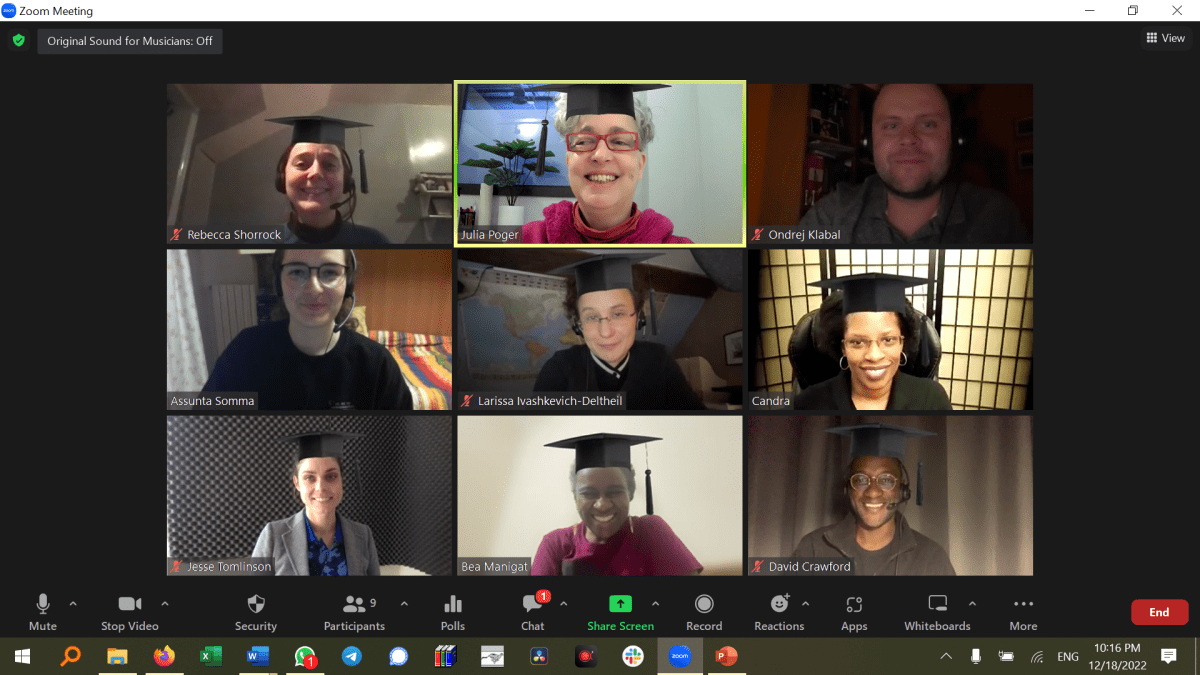
Given the kind of year this one has been, you would be hard pressed to find someone not making a comment – or two – about it. Believe us, we tried. Which is why we have decided to break with what has become the typical 2020 modus operandi, and not delve too deeply.
Yes, this has been quite the year, one like no other. It has been hard on many, tragic for some. But we would hate to make our last post of the year all about that pain, and that hardship.
That would be too sad, and not our style.
Yes, it was anything but easy. We have had to learn to live and deal with a completely new reality, and to adapt our lives to it, both on a personal level, and on a professional one too. KYW here being a living example of that very process.
But there have also been good things. Positive changes. New opportunities.
And we would like to focus on that.
Our community has grown, more than we could have imagined, and we have welcomed new members from all corners of the world, including some that we were not yet even planning to visit. It has been an exciting transformation, and you have all contributed to making the Know Your Worth course richer, and more dynamic. We have had to compensate for taking so much of it online, and find new ways of doing many things, but we feel like we rose to the challenge, and – thanks to you – were able to succeed. Needless to say, none of this would have been possible without your help, your trust, and your support, and for that we are eternally grateful.
Thank you for trusting us with your time, and your energy – we all know that traditional laws of physics don’t apply online – and thank you for being with us every step of the way.
We have learned much, and worked hard, and now we have come to the time where we can all enjoy some well-deserved rest.
Raise a glass, have something sweet, and let us all meet again in the new year. And please remember, you have been there for us, and KYW will always be there for you.






 Know Your Worth: Understanding Marketing and Negotiating for Interpreters